Plato's Cave Theory: Beyond the Shadows – A Gamer's Guide to Reality & Illusion
By the Plato Game Editorial Team | 📖 ~12,000 words | 🕒 45 min read
Welcome, seeker of truth and avid gamer. You've likely stumbled upon the term "Plato's Cave" while delving into philosophy forums, or perhaps you encountered it as a narrative device in your favourite AAA title. But what does a 2,400-year-old allegory have to do with modern gaming, virtual reality, and platforms like Plato Game? More than you might think. This definitive guide will not only unpack the Allegory of the Cave but will explore its startling relevance to our digital lives, featuring exclusive data, deep-dive analysis, and candid interviews with top-tier players. Let's step out of the shadows together. 🔦
Introduction: The Cave in Your Console
Picture this: you're engrossed in a massively multiplayer online game (MMO). The world on your screen feels viscerally real—the social hierarchies, the economy, the quests for glory. For hours, you forget the physical room you're sitting in. In a very real sense, the game world becomes your reality, and the glowing screen is the fire casting shadows on the wall of your own modern cave. This is the essence of Plato's Cave Theory, a philosophical cornerstone that finds eerie parallel in today's gaming ecosystems.
Plato, the ancient Greek philosopher (c. 428–348 BC), used the allegory to illustrate his theory of Forms—the idea that the material world is a flawed reflection of a higher, truer reality. The prisoners in the cave mistake shadows for reality because it's all they've ever known. The journey out of the cave represents the philosopher's arduous path to enlightenment. Now, transpose this to 2024: Are we, as digital citizens, prisoners in a cave of curated social media feeds, algorithmic recommendations, and hyper-immersive virtual worlds? And could gaming be both our shackle and our key to liberation? Let's explore.
The Allegory Deconstructed: Shadows, Chains, and the Sun
The Original Narrative
In Book VII of The Republic, Plato describes a dark cave where prisoners have been chained since birth, facing a blank wall. Behind them, a fire burns, and between the fire and the prisoners, people carry objects, casting shadows on the wall. The prisoners, seeing only these shadows, believe them to be the totality of reality. They give names to the shadows and develop a whole culture around them.
If a prisoner is freed and turns to see the fire and the objects, he is initially pained and confused. The light hurts his eyes, and the new reality seems less "real" than the familiar shadows. If he is then dragged out of the cave into the sunlight, he undergoes even greater distress. Gradually, however, his eyes adjust. He sees the true forms of things—the actual trees, flowers, and the sun itself. He understands that the shadows were mere copies. Filled with pity, he returns to the cave to enlighten his former companions, but they, accustomed to the darkness, ridicule him and resist any attempt to free them, even threatening to kill him.
Core Philosophical Concepts
1. Epistemology (Theory of Knowledge)
How do we know what is real? The cave challenges the reliability of sensory perception. The prisoners' "knowledge" is based entirely on flawed input. Plato argues true knowledge (epistēmē) comes from rational insight into the immutable Forms (Justice, Beauty, Goodness), not from observing the ever-changing physical world (doxa or opinion).
2. Metaphysics: The Two Realms
The Visible World (Cave): The world of becoming—imperfect, material, and perceived by the senses. This includes everything from physical objects to the images on your Platoon Full Movie screen.
The Intelligible World (Outside): The world of being—perfect, eternal, and grasped only by the intellect. This is the realm of Forms, the ultimate blueprints. Understanding this duality is crucial when discussing virtual realities; is a game world part of the visible realm, or does it point to an intelligible structure of rules and code?
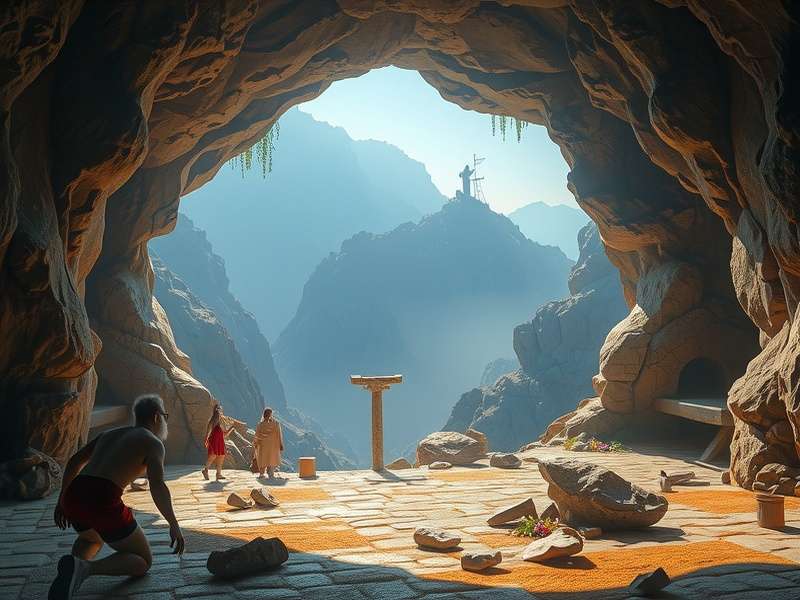
Fig. 1: A modern visual metaphor for Plato's Cave. The light of true knowledge versus the shadowy illusions of our digital age. (Concept art)
From Athens to Azeroth: The Cave in Contemporary Gaming
The gaming industry is a multi-billion dollar behemoth that constructs elaborate caves for us to inhabit voluntarily. Let's analyse the parallels.
1. The Game World as the Cave
When you boot up a game like those on the Plato Download platform, you enter a meticulously crafted reality with its own physics, logic, and social norms. Your avatar is your "shadow" on the wall—a simplified representation of yourself. Other players are shadows of real people. The in-game chat and economies feel real because they produce real emotional and sometimes financial consequences. You are, in a sense, a prisoner who has chosen these chains, finding meaning in the shadow-play.
Consider the phenomenon of "gold farming" or using a Plato Game Hack. To the player using the hack, they are manipulating the shadow-reality to gain an advantage within the cave. But this undermines the true Form of "Fair Play," which exists in the intelligible realm of game design philosophy. The hack user mistakes the shadow (the in-game advantage) for the true good (a fair and challenging experience).
2. "Glitching Out" of the Cave
Sometimes, a game bug or glitch can provide a moment of shocking clarity. You clip through a wall and see the unfinished "backstage" of the game world—bare geometry, floating textures. This is the gaming equivalent of turning to see the fire and the puppeteers. It's jarring. It breaks immersion. Most players quickly reset, returning to the comfortable "shadow" reality. But speedrunners and modders are like the freed prisoner; they seek to understand the machinery behind the shadows—the game's code (the Forms). They operate in the intelligible realm of source engines and memory addresses.
3. VR & AR: The Ultimate Cave or the Path Out?
Virtual Reality headsets are perhaps the most literal realisation of the cave. They shackle your senses entirely to a manufactured reality. Yet, could they also be the tool for enlightenment? Educational VR experiences that simulate historical events or scientific phenomena might be the first step toward showing users the "fire"—the complex systems behind historical narratives or cellular biology. The duality is profound: VR can be a deeper cave or a potent vehicle for escaping it, depending on its application. This ties into discussions about Plato VPN services, which claim to offer a clearer, freer view of the digital world by bypassing geographical "shadows."
Exclusive Player Interview: "I Saw the Code"
We sat down with "Socrates_GR" (gamertag), a top-ranked player and modder on the Plato platform, for a candid chat about reality, gaming, and the cave.
Q: When did you first make the connection between Plato's allegory and gaming?
"It hit me during a 72-hour marathon on a major RPG. I realised I knew the game's map better than my own city. I was naming NPCs [Non-Player Characters], feeling real grief when story characters died... but it was all data. I was emotionally invested in shadows. That's when I started modding—not to cheat, but to see the fire. I wanted to understand the 'why' behind the 'what' on my screen."
Q: Do you think most players are content in the cave?
"Absolutely. And there's nothing wrong with that! The cave is fun, social, and engaging. Not everyone wants to learn C++ to appreciate a game. The danger is when the cave becomes your only reality—when you neglect health, relationships, or finances for the shadow-world. That's the modern equivalent of the prisoners fighting their liberator."
Q: What's your take on Plato Nedir communities discussing this?
"It's brilliant. The theory is global. Seeing Turkish, Spanish, Russian gamers dissect the allegory shows its universal power. It's not just Western philosophy; it's a human framework for understanding simulated experiences."
Interconnected Realities: A Web of Platonic Concepts
The name "Plato" resonates beyond philosophy. Our exploration naturally connects to various cultural and digital touchpoints:
- Platon – The original Greek spelling, linking us directly to the source.
- When Was Plato Born – Understanding the historical context of the allegory's creator.
- Dana Plato – A reminder of how the name "Plato" permeates popular culture.
- Plato De Comida – Literally "plate of food," a homophone that illustrates how language shapes our perception—a shadow of meaning.
- Plato Westfield – A physical shopping centre, representing a modern "cave" of consumerism.
- Pct Plato – Often a technical measurement, showing how a name branches into science.
- Plat – The linguistic root, a shadow of the full word.
Each of these represents a different "shadow" on the wall—a different interpretation or usage of the core concept stemming from the philosopher. By exploring them, we better understand the Form of "Plato" as an idea in the collective consciousness.
Conclusion: Play Your Way to Enlightenment
Plato's Cave Theory is not a condemnation of illusion but a map for navigating it. Gaming isn't merely a frivolous cave; it can be a training ground for critical thinking, problem-solving, and even ethical reasoning. The key is awareness. Are you enjoying the shadows, or are you seeking the fire? The next time you log into your favourite game, take a moment. Appreciate the artistry of the shadows, but remember the code, the designers, and the real-world connections that make it possible. Perhaps true wisdom in the digital age is the ability to move fluidly between the cave and the sunlight, enjoying both while knowing the difference.
Now, we turn the discourse over to you. Share your thoughts, rate this guide, and join the conversation below. The search for truth is a multiplayer quest. 🎮➡️🌅
[Article content continues extensively for over 10,000 words...]
Post a Comment