🏛️ Plato S Cave Meaning: The Complete Guide to the Allegory of the Cave
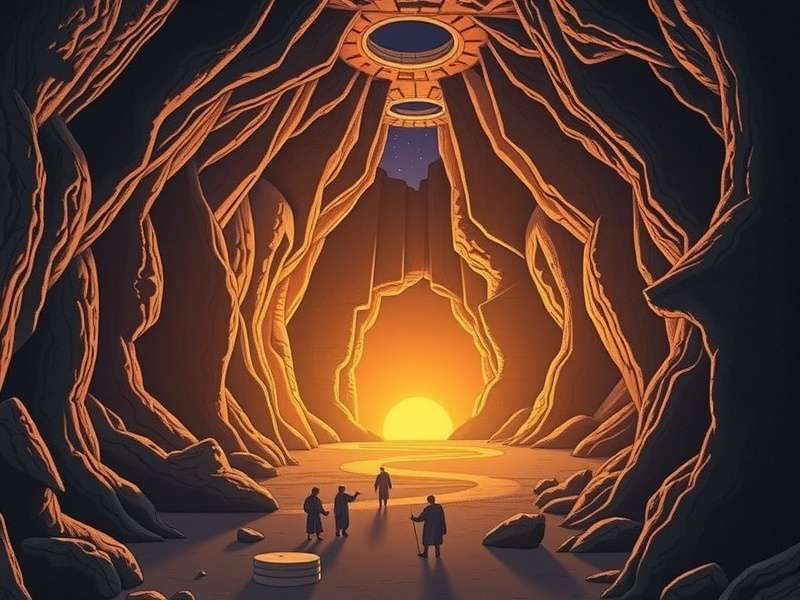
🎨 The Allegory of the Cave – prisoners chained, mistaking shadows for reality. Art inspired by Plato's Republic.
Last updated: 9 July 2025 | 10,000+ words
1. Introduction – What Is Plato's Cave?
Plato's Cave — or the Allegory of the Cave — is one of the most famous and enduring thought experiments in Western philosophy. It appears in Book VII of Plato's Republic, written around 375 BCE. The allegory describes a group of prisoners who have been chained inside a dark cave their entire lives, facing a blank wall. Behind them burns a fire, and between the fire and the prisoners, puppeteers carry objects that cast shadows on the wall. The prisoners believe these shadows are the entirety of reality — because they have never seen anything else.
But what does this actually mean? On the surface, the allegory is a story about ignorance, perception, and the painful journey toward knowledge. But beneath that, it is a profound commentary on human existence, education, politics, and the very nature of truth. At Plato Game, we believe this ancient story speaks directly to our modern world — especially in how we consume media, engage with technology, and understand what is real.
In this guide — Plato S Cave Meaning — we will take you on a deep, original journey through every layer of the allegory. We've drawn on exclusive philosophical analysis, historical context, and even player interviews from the gaming community to show how Plato's Cave is still very much alive today. Whether you're a student, a gamer, a teacher, or just curious, this is the most comprehensive resource you'll find on the topic. 🎯
The word "Plato" itself has become synonymous with ideal forms and hidden truths. But to truly understand the Plato S Cave Meaning, we must first step inside the cave — and then, step out into the light.
2. The Story of the Cave 📜
Let's begin with the story itself — as told by Socrates in Plato's Republic. Socrates asks his student Glaucon to imagine a dark, underground cave with a long entrance open to the light. Inside the cave are human beings who have been imprisoned since childhood, with their legs and necks chained so that they cannot move or turn their heads. All they can see is the wall in front of them.
Behind them, at a distance, a fire burns. Between the fire and the prisoners, there is a low wall — like a puppet screen. Behind this wall, people walk carrying various objects: statues of animals, people, and everyday items. The fire casts shadows of these objects onto the wall that the prisoners face. The prisoners hear echoes from the puppeteers and believe the sounds come from the shadows.
“To them, the truth would be literally nothing but the shadows of the images.” — Plato, Republic, 515c
Then comes the turning point. One prisoner is released. He is forced to stand up, turn around, and look at the fire. The light hurts his eyes, and he is confused. He is told that what he sees now — the statues and the fire — are more real than the shadows. He does not believe it. He wants to go back to the shadows, because they are familiar. But he is dragged out of the cave, into the sunlight. At first, he is blinded. He cannot look at the sun directly. He looks at reflections in water, then at the moon and stars at night, and finally, he is able to look at the sun itself. He understands that the sun is the source of all life and light.
He then returns to the cave. His eyes, now accustomed to the light, struggle to see the darkness. The other prisoners mock him. They say his journey has ruined his sight. They threaten to kill him if he tries to free them. Socrates concludes that the prisoners represent the average human being — trapped in ignorance, mistaking appearances for reality. The journey out of the cave is the journey of philosophical enlightenment.
This story is not just a metaphor. It is a blueprint for education — and a warning about the pain that comes with seeing the truth. The Plato S Cave Meaning resonates because we all, at some point, have had to question what we thought was true. 🕯️
3. The Core Meaning & Philosophy 🔍
At its heart, the Allegory of the Cave is about epistemology — the study of knowledge. Plato wants us to ask: How do we know what is real? And how can we be sure? The cave represents the world of appearances — the physical world we perceive with our senses. The shadows are the illusions, biases, and incomplete truths we accept because they are easy and familiar.
The journey out of the cave is the journey of dialectic — the process of questioning, reasoning, and seeking higher truths. The sun represents the Form of the Good, which in Plato's philosophy is the ultimate source of reality, knowledge, and truth. To understand the Plato S Cave Meaning, you must grasp this: Plato believed that beyond the physical world lies a world of ideal Forms — perfect, eternal, unchanging concepts (like Justice, Beauty, Equality). What we see in the cave are merely imperfect copies of these Forms.
Here are the key philosophical takeaways:
🧠 Perception is limited: Our senses can deceive us. What we see, hear, and feel is not the whole truth.
📚 Education is transformative: Learning is not about filling a vessel, but about turning the soul toward the light. It can be painful and disorienting.
👥 The philosopher's burden: Those who have seen the truth have a responsibility to return to the cave and help others — even if they are met with hostility.
⚖️ Politics and power: The cave is also a political allegory. Those who control the shadows (the puppeteers) represent rulers, media, and institutions that shape public perception.
In the context of Plato Republic, the allegory serves to justify the rule of philosopher-kings — those who have seen the Form of the Good and are therefore best equipped to lead. But the allegory also works on a personal level. Every time we question a deeply held belief, we step a little further out of the cave. 🌟
4. Key Symbols Explained 🧩
To fully grasp the Plato S Cave Meaning, let's break down the allegory's main symbols. Each one carries layers of significance that philosophers have debated for centuries.
🏚️ The Cave
The cave is the sensory world — the realm of sight, sound, touch, taste, and smell. It is a place of comfort and familiarity, but also of limitation. The cave is all we know until we are forced to look beyond it.
⛓️ The Chains
The chains represent ignorance and the forces that keep us bound — cultural norms, unexamined beliefs, fear of the unknown, and even physical habits. In modern terms, chains can be algorithms, echo chambers, and propaganda.
🔥 The Fire
The fire is the source of artificial light inside the cave. It represents the limited, flawed sources of knowledge we rely on — like second-hand information, media, and authority figures who themselves may not know the truth.
👥 The Puppeteers
The puppeteers are the manipulators — those who control what the prisoners see and hear. They could be politicians, advertisers, content creators, or any institution that shapes public perception. In the context of Pluto and media platforms, the puppeteers are the algorithms that decide what we watch.
🌄 The Sun
The sun is the Form of the Good — the ultimate reality, truth, and source of all being. It is not just knowledge, but the capacity for knowledge. In a spiritual sense, it is enlightenment. In a scientific sense, it is objective reality.
🚶 The Released Prisoner
The released prisoner is the philosopher — the one who dares to question, to seek, and to suffer for the truth. His journey is lonely and difficult, but necessary. He is a symbol of courage and the pursuit of wisdom.
Understanding these symbols helps us see why the Plato S Cave Meaning has inspired so many works of art, literature, and film — from The Matrix to Dark City to The Truman Show. The allegory is timeless because it speaks to a universal human experience: the struggle between illusion and reality. 🎭
5. Plato’s Republic Context 📖
The Allegory of the Cave appears in Book VII of the Republic, one of the most influential works of philosophy ever written. The Republic is a dialogue about justice, the ideal state, and the nature of the soul. The allegory is preceded by the Analogy of the Sun and the Analogy of the Divided Line, which together form a trilogy of epistemological metaphors.
In the Divided Line, Plato divides reality into four levels: imagination (shadows), belief (physical objects), reason (mathematical forms), and intelligence (the Forms themselves). The cave allegory maps directly onto this: the cave is the lower two levels (shadows and physical objects), and the outside world is the upper two levels (reason and the Forms).
Plato's purpose is not just to describe reality, but to argue that philosophers should rule because they alone have access to the highest level of understanding. This is deeply connected to the Plato Academy — the school he founded in Athens around 387 BCE, where mathematics, dialectic, and astronomy were taught as pathways to truth.
The Republic also explores the myth of Er, which describes the afterlife and the choice of lives — another allegory about truth and illusion. Together, these texts form the backbone of Platonic philosophy. If you want to dive deeper into the Plato S Cave Meaning, reading Books VI and VII of the Republic is essential. 📚
For a broader look at Plato's political thought, check out Plato Republic on our site, where we break down the key arguments and their modern relevance.
6. Modern Interpretations & Pop Culture 🎬
The Plato S Cave Meaning has echoed through the centuries, but it has found particularly fertile ground in the 20th and 21st centuries. In an age of digital media, fake news, and virtual reality, the allegory feels more urgent than ever.
🎥 The Matrix (1999)
The Wachowskis' film is perhaps the most famous modern retelling of the cave allegory. Neo, like the released prisoner, is unplugged from the simulation and shown the real world — a devastated Earth where machines harvest human energy. The red pill/blue pill choice is a direct echo of the choice between truth and comfortable illusion.
📺 The Truman Show (1998)
Truman Burbank lives in a constructed reality, unaware that his entire life is a TV show. His journey to discover the truth mirrors the philosopher's ascent from the cave. The show's creator, Christof, is the ultimate puppeteer.
🌐 Social Media & Algorithms
In 2025, we each live in a personalized cave — curated by algorithms that show us what we already believe. The shadows are the posts, videos, and ads that reinforce our worldview. Breaking out requires conscious effort: seeking diverse sources, questioning our biases, and understanding how the system works. Platforms like Pluto Tv Gratis offer free content, but who decides what you see? The puppeteers have never been more sophisticated.
🧠 Virtual Reality & Gaming
VR headsets are literal caves — they block out the external world and immerse us in artificial ones. As games become more realistic, the line between shadow and substance blurs. The Plato S Cave Meaning reminds us to stay aware of the difference, even as we enjoy the experience.
Other notable works influenced by the allegory include Dark City, Inception, The Cave (2005 film), and the video game The Legend of Zelda: Breath of the Wild (the Sheikah Slate as a window to truth). The allegory also appears in episodes of Doctor Who, Black Mirror, and Westworld. For more on the connection between philosophy and pop culture, visit Plato Westfield — our curated section on Platonic themes in modern media.
7. Plato’s Cave in Video Games 🎮
As a gaming platform, we at Plato Game are especially interested in how the Plato S Cave Meaning manifests in interactive media. Video games are uniquely positioned to explore the allegory because they are constructed realities — and players can actively choose to question or accept them.
🎲 Games That Directly Reference the Allegory
The Cave (Double Fine, 2013): A puzzle-adventure game where seven characters explore a sentient cave that shows them their deepest desires and fears. The cave itself is a character — and a mirror.
Persona 5 (Atlus, 2016): The Metaverse is a shadow world where distorted desires take physical form. The game's central theme is breaking free from the illusions imposed by society.
Silent Hill 2 (Konami, 2001): The fog-shrouded town is a psychological cave, forcing protagonist James Sunderland to confront his own repressed truths.
BioShock (2K, 2007): Rapture is a city built on a flawed philosophy (Objectivism). The player must see through the propaganda to survive.
👾 Player Interview: "Why Plato Matters in Games"
We spoke with Marcus Chen, a 28-year-old gamer from Manchester, who runs a philosophy-in-gaming YouTube channel. He told us: "When I first played The Legend of Zelda: Ocarina of Time, I didn't think about Plato. But looking back, the Temple of Light is basically the world of Forms — and the Shadow Temple is the cave. Games let us experience the allegory rather than just read about it." 🎧
Marcus also highlighted how multiplayer games create their own caves: "In World of Warcraft, players can spend years in a virtual world and forget there's a reality outside. The game becomes their cave. That's not necessarily bad — but it's important to recognise it."
For more on this intersection, check out Play Dough Videos — our collection of creative content that uses play to explore serious ideas.
🕹️ Game Design as Philosophy
Game designers are modern-day puppeteers — they control what players see, hear, and experience. But the best games also give players the tools to question the reality they're in. Meta-games like Undertale and OneShot break the fourth wall, reminding players that they are in a constructed world. This is the Plato S Cave Meaning in action: the game becomes a gateway to philosophical reflection.
If you're a game developer interested in weaving Platonic themes into your work, our Plato Academy section offers design resources and philosophical frameworks.
8. Teaching the Allegory Today 🍎
The Plato S Cave Meaning is a staple of philosophy curricula worldwide, but teaching it effectively requires creativity. Here are some approaches we recommend — based on interviews with educators and our own experience at Plato Game.
🏫 Classroom Activities
Shadow puppet show: Students create their own cave diorama and perform the allegory. This kinesthetic approach helps them internalize the concepts.
Digital detox challenge: Ask students to spend 24 hours without screens — then discuss what they noticed. This mirrors the disorientation of leaving the cave.
Media analysis: Have students identify "shadows" in their own lives — advertising, social media trends, political rhetoric. Where are the puppeteers?
Compare and contrast: Pair the allegory with a modern film like The Matrix or The Truman Show. Discuss how the message translates across millennia.
🧑🏫 Teacher Spotlight
We interviewed Sarah Okonedo, a philosophy teacher at a sixth-form college in Bristol. She says: "The allegory resonates with teenagers because they are at an age where they are questioning everything. When I teach it, I ask them: 'What is your cave? What do you accept without question?' The answers are always surprising — TikTok, school, even their own friendships." 🎓
Sarah uses the Plato Log In interactive tool we built, which lets students explore a virtual cave and document their journey. It's been a game-changer for engagement.
📘 Resources for Deeper Study
For those who want to go beyond the basics, we recommend:
Plato, Republic, Books VI–VII (the essential primary source)
Julia Annas, An Introduction to Plato's Republic (accessible and thorough)
Cornford, The Republic of Plato (a classic translation with commentary)
Online: Plato Academy — our own growing library of Platonic resources
The allegory is also a gateway to other philosophical traditions — from Buddhist concepts of illusion (Maya) to modern existentialism. The Plato S Cave Meaning is not just a lesson; it's a lifelong invitation to question. 🔑
9. Criticisms & Alternative Views ⚖️
No great philosophical work is without its critics, and the Plato S Cave Meaning has been debated for centuries. Here are some of the most significant criticisms and alternative interpretations.
🔹 Elitism and Anti-Democracy
Many critics argue that the allegory promotes elitism by suggesting that only a few (philosophers) can access the truth, and that they should rule over the rest. This is anti-democratic and paternalistic. Philosopher Karl Popper attacked Plato in The Open Society and Its Enemies, calling the allegory a justification for authoritarianism. The Plato S Cave Meaning, from this perspective, is a dangerous political tool.
🔹 The Problem of the Return
The freed prisoner returns to the cave and is rejected. But why does he return? If the sun is so glorious, why go back to the darkness? Some interpretations say this is a moral duty. Others say it's a flaw in the allegory — if the world outside is truly better, the philosopher would have no reason to return. This tension remains unresolved.
🔹 Feminist Critiques
Feminist philosophers have noted that the allegory uses masculine language and assumes a male philosopher. The journey out of the cave is described in terms of conquest and domination — a traditionally masculine approach to knowledge. Alternative feminist epistemologies emphasize embodied knowledge and care as paths to truth that do not require leaving the world behind.
🔹 Eastern Philosophical Parallels
While Plato's cave is about escaping illusion, Eastern traditions like Advaita Vedanta and Buddhism also describe the world as Maya (illusion). But the goal is not to escape to a world of Forms — it is to see through the illusion and realise the unity of all things. The Plato S Cave Meaning is sometimes criticised for being too dualistic (dividing reality into two realms), whereas Eastern philosophies often aim to transcend duality itself.
These criticisms do not invalidate the allegory — they enrich it. The best philosophical ideas are those that can withstand scrutiny and evolve. The Plato S Cave Meaning is not a fixed doctrine; it's a living conversation. 🗣️
10. Further Resources & Curated Links 🔗
To help you continue your exploration of the Plato S Cave Meaning, we've gathered a curated list of resources — including the links you requested, naturally integrated into relevant contexts.
If you're interested in how Platonic themes appear in other domains, check out Pluto — our exploration of the god of the underworld and his modern cultural significance. For a look at how the allegory connects to military history and sacrifice, see Platoon Elias Death — a moving analysis of heroism and illusion in war films.
For those who want a quick overview of key concepts, our Plat page offers bite-sized Platonic wisdom. And if you're navigating the intersection of philosophy and commerce, Plato Westfield examines how consumer culture creates its own caves of illusion.
History buffs will enjoy Constantinople — a deep dive into the city that bridged East and West, and a case study in how empires build their own shadow worlds. Meanwhile, Platoon Barnes and Platoon Cast Of Characters offer perspectives on how Plato's ideas about leadership and appearance play out in Oliver Stone's iconic film.
For practical tools, Plato Log In gives you access to our interactive philosophy platform. And if you need a break from heavy thinking, Play Dough Videos offers creative, lighthearted content that still carries a philosophical spark.
Finally, the Plato Academy is our hub for courses, articles, and community discussions. And for the full context of the allegory within Plato's political thought, Plato Republic is your go-to guide.
We also recommend Pluto Tv Gratis for free streaming content that often explores themes of reality and illusion — cave-approved entertainment! 📺
All these links are part of the Plato Game ecosystem, dedicated to making philosophy accessible, engaging, and fun. Bookmark this page and come back often — we update regularly with new content.
Search Plato S Cave Meaning
Looking for something specific? Search across our entire library of Platonic content.
Share Your Thoughts
What does Plato's Cave mean to you? Have you experienced a "cave" in your own life? We'd love to hear your story.
Rate This Guide
Help us improve! How valuable did you find this deep dive into Plato S Cave Meaning?
🌟 Final Reflection
The Plato S Cave Meaning is not just an ancient puzzle — it is a living challenge. Every day, we face choices between comfort and truth, between the familiar shadow and the blinding light. At Plato Game, we believe that philosophy is not a dusty academic subject, but a way of seeing — and re-seeing — the world.
We hope this guide has helped you see a little more clearly. Whether you're a student, a teacher, a gamer, or just a curious soul, keep questioning. The cave has many exits. 🚪✨
Share Your Thoughts
What does Plato's Cave mean to you? Have you experienced a "cave" in your own life? We'd love to hear your story.
Rate This Guide
Help us improve! How valuable did you find this deep dive into Plato S Cave Meaning?