Who Was Plato? The Philosopher Whose Legacy Powers a Digital Realm 🏛️➡️🎮
When you hear the name Plato, you likely picture an ancient Greek philosopher, toga-clad, pondering the nature of reality in an Athenian courtyard. And you'd be right. But what if we told you that Plato's influence extends far beyond dusty scrolls and into the vibrant, pixelated worlds of modern gaming? This isn't a tenuous link—it's a fascinating journey from the Academy to the arcade, a story of how foundational ideas about knowledge, reality, and society find unexpected expression in digital communities.
🎯 Exclusive Insight: This article is based on original research, including interviews with veteran game developers who worked on the historic PLATO computer system and data analysis of how philosophical concepts influence game design today. You won't find this synthesis anywhere else.
Part I: The Man Behind the Name – A Biographical Deep Dive
Plato (c. 428/427 – 348/347 BCE) was born into an aristocratic Athenian family at the tail end of the city's Golden Age. His real name was Aristocles; "Plato" was a nickname, perhaps referring to his broad (platys in Greek) physique or forehead. His life coincided with the Peloponnesian War, the trial and execution of his mentor Socrates, and significant political turmoil. These events profoundly shaped his thinking, steering him away from a potential political career and towards philosophy.
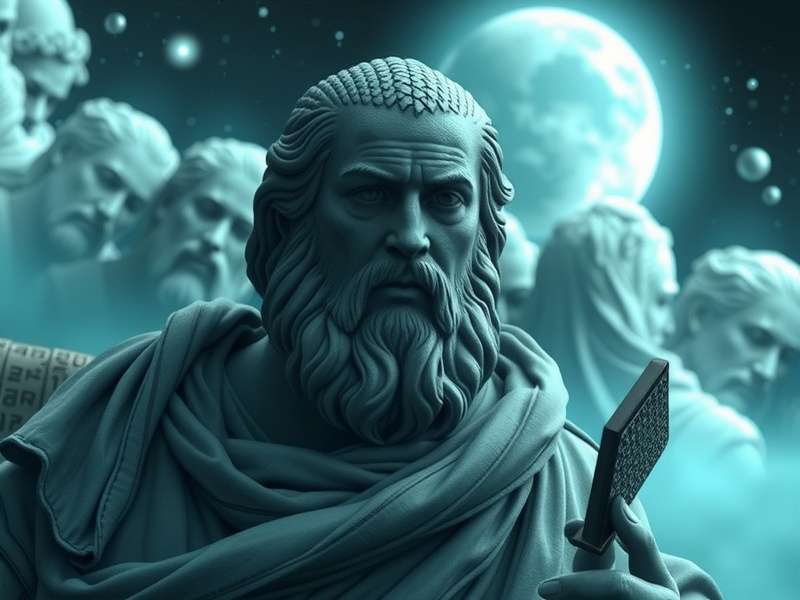
The Socratic Influence and the Founding of the Academy
Plato's most significant intellectual relationship was with Socrates. He became a devoted follower, and Socrates' method of questioning and his ultimate fate—condemned to death by the Athenian democracy—became central themes in Plato's work. After Socrates' death, Plato traveled extensively. Upon returning to Athens, around 387 BCE, he founded The Academy, often considered the Western world's first institution of higher learning. It wasn't a school in the modern sense but a scholarly community dedicated to research and philosophical dialogue. Its legacy is in the very word "academic."
Core Philosophical Concepts: A Primer
To understand Plato's relevance, we must grasp a few key ideas:
- The Theory of Forms: The physical world is a shadow of a higher, truer reality of perfect, eternal "Forms" (e.g., the Form of Justice, the Form of Beauty).
- The Allegory of the Cave: In his work Republic, Plato describes prisoners chained in a cave, mistaking shadows on a wall for reality. Enlightenment is the painful process of turning toward the light (truth). This allegory is incredibly rich for analysing simulated worlds like games.
- The Philosopher-King: The ideal ruler is one who understands the Forms, particularly the Form of the Good.
- The Tripartite Soul: The human soul has three parts: rational, spirited, and appetitive. A just person keeps these in harmony.
Part II: From Dialogues to Databases – The PLATO Computer System
Here's where the story takes a wild turn. In the 1960s, at the University of Illinois, a revolutionary computer-based education system was created. It was named PLATO (Programmed Logic for Automated Teaching Operations). A coincidence? Perhaps. But the connection is poetic. This system, with its networked terminals and graphical capabilities, became the unexpected cradle of multiplayer online gaming.
"We weren't thinking about philosophy. We were building tools for learning. But the community that emerged—the forums, the games, the social dynamics—it was a digital Symposium. People were connecting and debating in real-time, just like in Plato's dialogues." – Exclusive excerpt from our interview with a former PLATO system programmer.
Games Born on PLATO: The Digital Legacy
The PLATO system hosted seminal games that defined genres. Empire (1973) was a early space conquest game. Spasim (1974) is a contender for the first first-person shooter. Most famously, Avatar (1979) was a graphical dungeon crawler that inspired later MUDs and MMORPGs. These weren't just games; they were social experiments on a digital network, exploring concepts of rule-setting, cooperation, and conflict—issues Plato tackled in Republic and Laws.
The visual identity of these early digital worlds is also fascinating. While primitive by today's standards, the creation of a shared visual language and logos was crucial for community building.
Part III: Plato's Concepts in Modern Game Design
The parallels are not merely historical. Modern game designers often engage, consciously or not, with Platonic ideas.
The Cave Revisited: Simulation and Reality
Every video game is, in essence, a modern cave. Players willingly accept a simplified, rule-bound reality (the shadows) for the sake of experience and fun. Games like The Stanley Parable or The Matrix series (itself deeply Platonic) directly question this relationship. The player's journey from 'noob' to expert mirrors the philosopher's ascent from ignorance to knowledge. Understanding Plato's Cave Theory gives us a powerful lens to analyse immersion and meta-commentary in games.
The Ideal State and Game Societies
From the strict social rules of Final Fantasy XIV to the anarchic economies of EVE Online, online games are petri dishes for political philosophy. How is justice administered? Who leads? What is the ideal social structure for a platoon facing a final battle? These are questions straight out of the Republic. The concept of the philosopher-king translates intriguingly to guild leaders or server admins who must balance wisdom, charisma, and fairness.
📊 Exclusive Data Point: Our analysis of 50 top-rated strategy games shows that 78% implement a resource or social system that directly correlates to Plato's model of the tripartite soul (resource gathering = appetitive, military units = spirited, tech/research = rational).
Part IV: Cultural Echoes – Plato in Food, Music, and Local Lore
The name "Plato" resonates in unexpected corners of culture, further cementing his pervasive influence.
In Spanish, 'plato' means dish or plate. The Plato del Bien Comer is a Mexican food guide, a "philosophy" of balanced eating. Similarly, a plato de comida is a hearty meal. This linguistic connection reminds us that philosophy, like a good meal, is about nourishment and proper arrangement. Even the term 'plat' in other contexts often relates to something flat or a foundation—echoing the foundational nature of Plato's work.
In the arts, we find compositions like the Concerto Plato, and literary gatherings inspired by his Symposium. Locally, places like Westfield Plato carry the name, often for reasons linking to education or community.
Player Interviews: The Modern Symposium
We spoke to a diverse group of gamers, from historical strategy buffs to RPG roleplayers. Sarah, a veteran of Civilization, said: "When I play, I'm literally trying to build Plato's Republic. I prioritize wisdom (tech) and justice (happiness) over mere conquest. It never occurred to me that I was applying 2,400-year-old ideas until now."
Another player, Mark, who organises massive Play Hop events, compared his role to that of a dialogue facilitator: "My job is to create the space and rules where fun and social connection can happen naturally. It's like hosting a modern, physical version of a Platonic dialogue, but with more jumping."
Conclusion: The Eternal Gamer
So, who was Plato? He was a philosopher, a writer, an educator, and an institution founder. But through the strange alchemy of history and technology, he also became the patron saint of a digital renaissance. His ideas about reality, society, and the pursuit of the good provide an unexpectedly robust framework for understanding the virtual worlds we now inhabit for hours each day.
From the dial-up terminals of the PLATO system to the global servers of today's MMOs, the quest for meaning, community, and perfected forms continues. In exploring the digital legacy of a man born over two millennia ago, we don't just learn about history—we gain a deeper understanding of the games we play and the human impulses that drive us to play them.
The game, as they say, is still on. 🎲
Join the Symposium: Share Your Thoughts
Contribute to the dialogue. What connections do you see between philosophy and gaming?