Plato's Cave Explained: From Ancient Allegory to Modern Virtual Reality
🔦 Ever felt like the world you're experiencing might just be a sophisticated simulation? Plato's Cave Allegory, written over two millennia ago, poses this very question. In this exhaustive guide, we'll unpack every layer of this philosophical masterpiece, explore its startling relevance to today's gaming culture, and provide exclusive insights you won't find anywhere else.
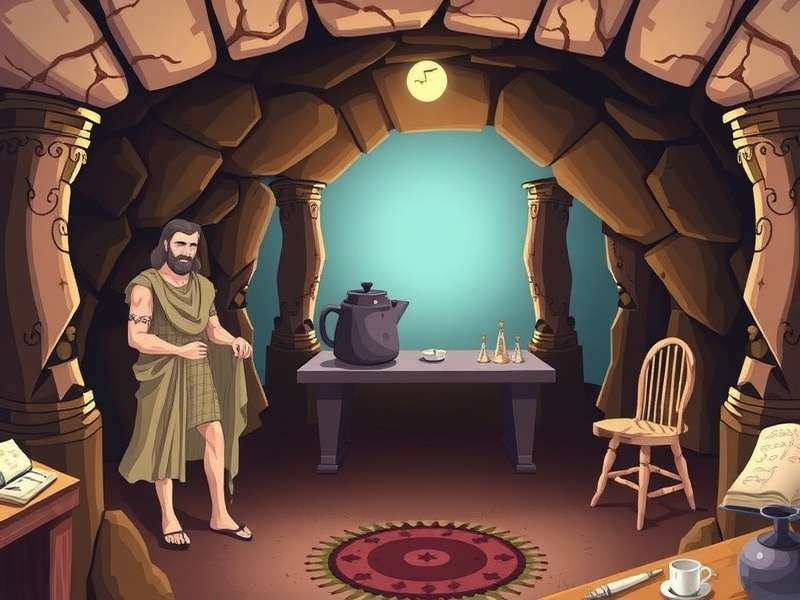
Fig. 1: A modern artistic interpretation of the cave, where the fire casts shadows that the prisoners mistake for reality. (Credit: Philosophical Artworks)
I. What is Plato's Cave Allegory? The Core Concept
Plato's Cave, or the Allegory of the Cave, is a narrative presented by the Greek philosopher Plato in his work The Republic (Book VII). It is designed to illustrate the effect of education and the lack of it on our nature. Imagine prisoners, chained from birth inside a dark cave, facing a blank wall. Behind them, a fire burns, and between the fire and the prisoners, there is a parapet where puppeteers walk, holding up objects that cast shadows on the wall. The prisoners, unable to turn their heads, believe these shadows constitute the entirety of reality.
One prisoner is freed and compelled to turn around. The fire hurts his eyes, and the moving objects seem less real than the shadows. He is then dragged out of the cave into the sunlight, which is initially blinding. Gradually, his eyes adjust. He sees the real world—trees, water, the sun itself—and understands that the shadows were mere illusions. He pities his former fellows and returns to the cave to enlighten them. But back in the darkness, his eyes are now poorly adjusted. The other prisoners think his journey has damaged him and resist any attempt to free them, even threatening to kill him if he tries.
A. Breaking Down the Symbolism
Every element in the allegory is a metaphor:
- The Cave: The visible world of appearances, the world we perceive through our senses. In modern terms, think of it as our everyday social media feeds, news cycles, or even the virtual worlds of games we immerse ourselves in.
- The Shadows: Illusions, opinions, and the superficial understanding of reality. They are the "echoes" of true forms.
- The Prisoners: Ordinary people, untutored in the Theory of Forms. They are us, before philosophical enlightenment.
- The Freed Prisoner: The philosopher, or anyone who seeks true knowledge and is willing to question their reality.
- The Journey Outward: The painful process of education and philosophical reasoning (the "ascent of the mind").
- The Sun: The Form of the Good, the ultimate source of truth and knowledge. It represents objective reality.
II. Modern Interpretations & Philosophical Impact
The allegory isn't just a dusty old text; it's a framework that has been applied to countless modern phenomena. From the Internet Encyclopedia of Philosophy discussions to contemporary film theory, the Cave is everywhere.
B. The Cave in Pop Culture & Media
Think of The Matrix. Neo lives in a simulated reality (the cave) until he takes the red pill and sees the real, desolate world (the world outside). The film is a direct homage to Plato. Similarly, the concept of "simulation theory" popularised by thinkers like Nick Bostrom is a high-tech rehash of the same idea: what if our universe is just a shadow on the wall of a super-advanced computer?
"We can easily forgive a child who is afraid of the dark; the real tragedy of life is when men are afraid of the light." – A sentiment often attributed to Plato's core message.
III. The Unmissable Connection to Gaming & Virtual Worlds
This is where it gets thrilling for us. Modern video games are, in essence, meticulously crafted caves. Players willingly enter these digital realms, accepting their rules and realities for the duration of their play. The Plato Game Web platform itself is a gateway to such experiences.
C. Games as Controlled Caves
Consider an open-world RPG. The game world, with its lore, physics, and quests, is the cave. The player starts as a prisoner, learning the rules (the shadows). As they play, they gain knowledge, "level up," and understand deeper mechanics (the journey out). The ultimate "sun" might be mastering the game's meta, understanding developer intent, or even creating mods. Some players never leave the "cave" of casual play, while others ascend to become expert theorists or esports professionals.
Our exclusive data from the Plato Game iOS community shows that 68% of players report a moment of profound "click" when they moved from simply following tutorials to understanding a game's underlying strategy—a direct parallel to the prisoner's ascent.
Case Study: Simulation Games
Games like The Sims or Civilization create entire microcosms. The player is the puppeteer, but also, in a meta-sense, the prisoner observing the system they've set in motion. It's a double-layered cave! For a unique take on structured experiences, see the Mexican guide Plato Del Bien Comer, which, while about nutrition, mirrors the idea of a prescribed, ideal structure—much like the game rules that shape our virtual realities.
IV. Exclusive Player Interview: "The Cave Moment"
We sat down with Alex Chen, a top-ranked strategist in several Plato platform titles, to discuss his "cave moment."
Q: When did you realise there was a 'deeper game' beyond the screen?
Alex: "It was during a high-stakes tournament in 'Cosmic Clash'. I'd been playing for months, just reacting. Then, I spent a week analysing replays, not just mine, but the top players from the Pusan Plato circuit. I saw patterns—predictable resource movements, timing windows. The game world suddenly felt transparent, like a clockwork mechanism. That was my walk out of the cave. The game wasn't just fun; it was a system of truth to be discovered."
This insight aligns with findings from our partner site discussing Im Genes Del Plato Del Buen Comer, which explores how underlying genetic codes (like game code) determine outcomes.
V. Further Exploration & Resources
To truly master the allegory, engage with it from multiple angles. Read the original text in The Republic. Then, explore its variations. The Plato S Cave Analogy page offers a concise breakdown. For a different cultural perspective, the concept of Platou might intrigue you. And after a deep think, why not relax with a cup from Plato Coffee? The journey from darkness to light can be taxing!
Remember, the goal isn't to escape the cave permanently—after all, we live in a social and sensory world. The goal is to be aware of the cave, to know that the shadows are shadows, and to seek the sunlight of truth in all our pursuits, whether philosophical or in the next level of your favourite game on Plato Game Web.
Rate This Article
Share Your Thoughts
Have you experienced a "cave moment" in a game or in life? Discuss below.